
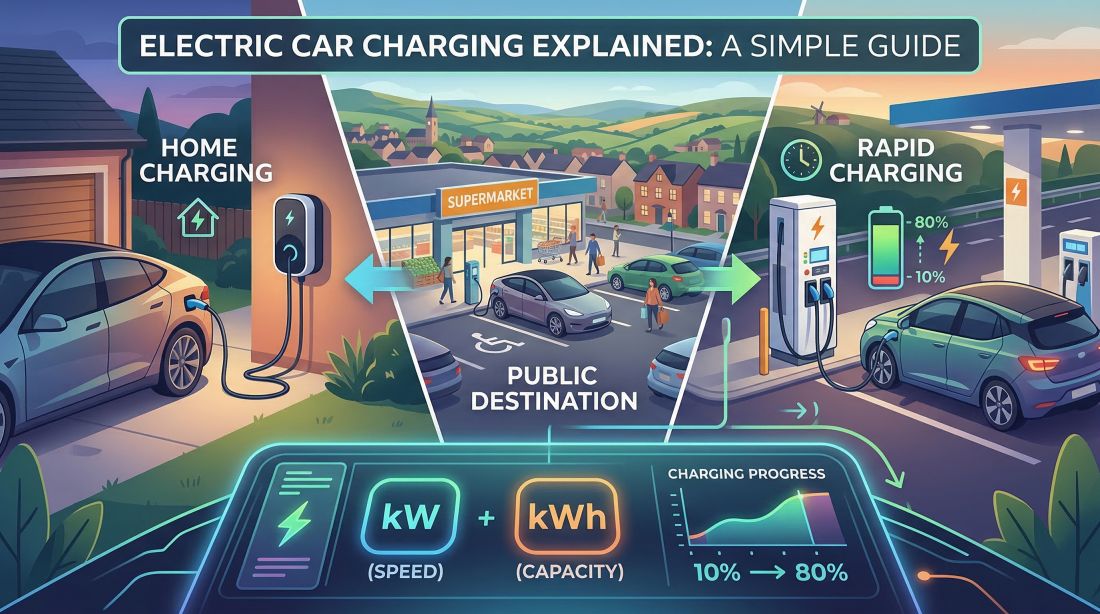
Beginner’s Guide to Electric Car Charging
Electric car charging can feel confusing at first — but once you understand the basics, it’s actually straightforward. Whether you’re considering your first EV or you’ve already got one on the driveway, this guide explains the key charging types, what the numbers mean, and how to build a simple charging routine.
If you’re currently looking at EV options, you can view our latest electric cars here: Used electric cars.
1) The 3 main ways to charge an electric car
Home charging (most convenient)
If you have off-street parking, home charging is usually the easiest option for day-to-day use. Most owners in Wales treat charging like charging a phone: plug in overnight, wake up with a “full tank”.
3-pin plug (standard socket): slow, but works for occasional top-ups
Home wallbox: faster and more practical for regular charging
Public destination charging (while you’re parked)
These are chargers in places you’d park anyway — supermarkets, car parks, leisure centres, workplaces. They’re ideal for topping up while you shop or work.
Rapid/ultra-rapid charging (for longer journeys)
These are the “quick stop” chargers you’ll often see at motorway services and main routes. They’re designed to add a useful amount of range quickly, especially on road trips across South Wales and beyond.
2) What do “kW” and “kWh” actually mean?
This is the bit that unlocks charging:
kW (kilowatts) = charging speed
Think of it like how fast the tap runs.kWh (kilowatt-hours) = battery size / energy used
Think of it like the size of the bucket (or how much water you used).
So a bigger battery (kWh) generally takes longer to fill — and a faster charger (kW) fills it quicker (as long as your car supports it).
3) Why people talk about “10% to 80%”
You’ll often hear EV drivers say “charge to 80%”. That’s because most EVs charge quickly up to around 80%, then slow down. This is normal and helps protect the battery.
For everyday driving, many owners charge to 80–90%, and only go to 100% when they specifically need maximum range.
4) Typical charging time expectations (simple guide)
Every EV is different, but as a beginner-friendly rule of thumb:
3-pin plug: best thought of as “overnight top-up” (slow)
Home wallbox: usually “overnight full/near-full” depending on battery size
Destination chargers: “add range while you’re parked”
Rapid chargers: “quick top-up on a longer trip” (often aiming for 80%)
5) What you need to get started
For home charging
A safe parking/charging setup (driveway is ideal)
Optional: a wallbox installation (many EV owners choose this)
For public charging
A contactless bank card often works on many chargers now
Some networks also use apps — you’ll get used to it quickly
Charging cables
Most EVs come with a charging cable (or you can buy one). Rapid chargers typically have their own cables attached.
6) A simple routine that works for most EV owners
If you’re in Ebbw Vale or anywhere in the Valleys doing typical daily driving, the routine for many EV owners looks like this:
Home charge for day-to-day convenience
Public top-ups when it suits (shopping/work)
Rapid charge only when travelling further
This is why EV charging often feels easier after the first week — it becomes part of your routine rather than a “fuel stop” you have to think about.
7) Choosing the right EV for your lifestyle
When you’re looking at used electric cars, the key is matching the car to:
your typical journeys (daily miles)
your charging access (home, work, public)
your comfort with planning longer trips
You can browse our current stock here: Used electric cars.
And if you’d like to talk it through in person, you can find us here: Directions to Bob Davies Car Sales.
Final thought
Electric car charging is less about “waiting around” and more about building a routine that fits your life — especially if you can charge at home. Once you know the difference between home, destination and rapid charging (and what kW/kWh mean), it becomes simple.
To explore EV options, view our latest stock here: Used electric cars. If you’re local to Ebbw Vale / South Wales, you’re welcome to visit us — come and see us.
Frequently Asked Questions
1) What’s the easiest way to charge an electric car day-to-day?
Home charging is usually the simplest — many EV owners just plug in overnight and top up as part of their routine.
2) What’s the difference between kW and kWh?
kW is charging speed (how fast energy goes in), while kWh is battery size/energy (how much the battery can store).
3) Why do people talk about charging from 10% to 80%?
Most EVs charge quickest up to around 80%, then slow down to protect the battery—so 10–80% is often the fastest “rapid charge” window.
4) Do rapid chargers always charge your EV at the advertised speed?
Not always — the car will only charge as fast as it’s designed to accept, and charging can slow as the battery gets fuller or if it’s very cold.
5) Do I need special apps or memberships to charge in public?
Sometimes, but many chargers now accept contactless card payment; apps can still be useful for finding chargers and checking availability.